The book in one line
A field guide to all 74 of your emotions and sensations — what each one measures, and what each one is for.
Fast facts
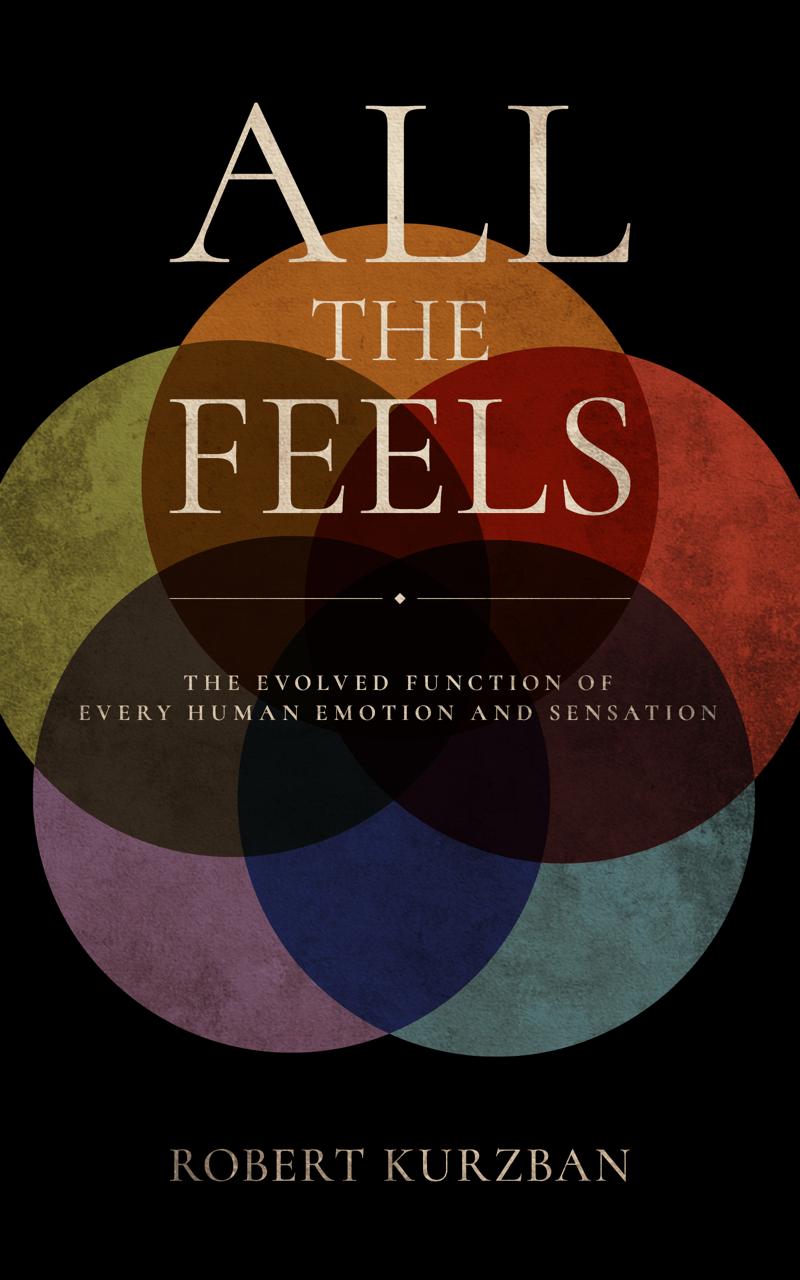
- TitleAll the Feels
- SubtitleThe Evolved Function of Every Human Emotion and Sensation
- AuthorRobert Kurzban
- On saleSeptember 30, 2026
- ISBN979-8-9966519-0-0 (paperback) · 979-8-9966519-1-7 (ebook)
- Page count499 pages
- Sources937 citations · 810 references
- CategoriesPsychology / Evolutionary Psychology · Science / Popular
- Websiteallthefeelsbook.com
Downloadable assets

Need a different format or resolution? Use the contact below.
About the book
Short description
A life without pain sounds wonderful. It would also be fatal. Pain feels bad because it has a job: measuring damage to your body and motivating you to protect it. Every other feeling has a job too, built by natural selection. Hunger measures your need for calories and motivates you to eat. Envy measures others’ success and motivates you to close the gap. Frustration measures the futility of your current approach and motivates you to try a new one.
In All the Feels, evolutionary psychologist Robert Kurzban explains the evolved function of every one of your emotions and sensations, from anger to the urge to yawn, organizing them the way biologists organize species, into four main Kingdoms—Body Maintenance, External Dangers and Opportunities, the Social World, Mind—and a final Kingdom, Monera, a cabinet of oddballs including déjà vu, pun pain, and the mysterious urge to squeeze something cute. Understanding what each feeling is measuring, what it’s asking you to do, and why, will change the way you think about your feelings.
Extended description
Why do we feel what we feel? All the Feels takes the radical-but-simple view that every feeling is a tool: a system that measures something about your situation and motivates a response that, over evolutionary time, paid off. Borrowing the structure of biological taxonomy, Kurzban sorts the whole emotional menagerie into five Kingdoms (Body Maintenance, External Dangers & Opportunities, the Social World, the Mind, and Monera) and eleven Phyla, right down to 74 individual Feels.
Along the way he explains why boredom is really a measure of opportunity cost — and how slot machines and social media are engineered to hijack it; why grief, of all things, has a function; what jealousy is actually tracking; and why a final "Monera" chapter of oddballs (pun pain, déjà vu, schadenfreude, the urge to squeeze something cute) resists tidy explanation. Witty, rigorous, and fully sourced, it's a new way to read your own inner life.
About the author

Short bio
Robert Kurzban is an evolutionary psychologist who was a professor of psychology at the University of Pennsylvania for over a decade. He is the author of Why Everyone (Else) Is a Hypocrite and coauthor of The Hidden Agenda of the Political Mind, both published by Princeton University Press. Steven Pinker described him as “genuinely clever, sly, succinct, and sometimes hilarious.” He writes the Substack The Living Fossils, where he explores how evolutionary ideas can help explain human psychology, especially the reasons behind human suffering and well-being. Now (mostly) retired, he is the junior partner in his sister’s new paint-your-own pottery studio in Philadelphia, The Pottery Spottery.
Research background
Kurzban trained with Leda Cosmides and John Tooby, the founders of evolutionary psychology, and was the first PhD from their Center for Evolutionary Psychology at the University of California, Santa Barbara. He has published more than a hundred scientific papers, cited more than 25,000 times, on why people stigmatize and exclude, how the mind keeps track of coalitions, why moral judgment looks the way it does, and what mental effort is. His papers have appeared in Psychological Review, Psychological Bulletin, Behavioral and Brain Sciences, the Annual Review of Psychology, and the Proceedings of the National Academy of Sciences. Full list on Google Scholar; more at robkurzban.com.
For interviews & bookings
Contact: rkurzban@gmail.com · Substack: thelivingfossils.substack.com · Author site: robkurzban.com
Advance praise
“Imagine if Darwin wrote a hilarious and accessible field guide to every feeling a person can have. That’s Kurzban’s All the Feels: a mind-blowing whistle-stop tour of why you feel everything from awe to embarrassment to loneliness to euphoria.”
— David EaglemanNeuroscientist, Stanford University; author of Livewired and Incognito
“A delightful and insightful tour of the garden of feelings. This is now the go-to volume for the panoply of emotion.”
— Martin E. P. SeligmanFounder of positive psychology; past president, American Psychological Association
“Kurzban has done more than anyone since Darwin to illuminate the evolutionary origins of human emotions. Read it to discover the true nature of humanity.”
— Michael ShermerFounding publisher of Skeptic magazine; longtime Scientific American columnist
“All the Feels is both wildly entertaining and deeply humane. Kurzban treats every human sensation, from hunger to heartbreak, as a small evolutionary marvel. I came away with even more compassion for the strange, feeling creatures we are.”
— Scott Barry KaufmanPsychologist; author of Transcend
“All the Feels makes a powerful case that the heart of human nature isn’t how we perceive, or how we think, but how we feel. Highly recommended for anyone who’s curious about the true richness and variety of human experience.”
— Geoffrey MillerEvolutionary psychologist; author of The Mating Mind and Spent
“Rob Kurzban creates the Elgin marbles of feeling — excising everything unnecessary until readers are left with a beautiful understanding of what each feel is, does, and is for. He does it with characteristic wit, humor, and extremely readable prose.”
— Jaimie KremsAssociate Professor of Psychology, UCLA
“All the Feels is an ambitious catalogue of all the feels… The book covers classics such as anger, grief, and love, as well as less intuitive but not less important feels such as the need to breathe, the feeling of knowing, and amusement. Very engrossing and entertaining. Highly recommended!”
— Daniel SznycerAssistant Professor of Psychology, Oklahoma State University
Reviews
“Extensively researched and thoroughly annotated… I enjoyed them, and I recommend them without hesitation.”
— Barry GoldmanThree Quarks Daily
Read the full review at Three Quarks Daily (18 August 2026; reviewed alongside Owen Jones, Force of Nature).
Suggested interview topics
- The big idea: why every feeling is a tool that measures something and motivates a response.
- Classifying emotion like Linnaeus classified life — 74 Feels sorted into five Kingdoms and eleven Phyla.
- How the attention economy hijacks boredom: slot machines, social media, and engineered reward.
- The surprising logic of grief — why we evolved to mourn at all.
- What jealousy, anger, and the other social emotions are really tracking.
- The “Monera” oddballs: pun pain, déjà vu, schadenfreude, and cute-aggression (gigil).
- Why the urge to pee belongs in the same book as love and awe.
- What an evolutionary view of feelings means for everyday life and mental health.
Quick Q&A
What does it mean to say a feeling has a “job”?
Each feeling is built to track a specific feature of your situation and nudge you toward a response that, on average, helped your ancestors. Hunger tracks a calorie deficit and pushes you to eat; frustration tracks a strategy that isn't working and pushes you to change tack or quit.
Why organize the book as a taxonomy?
Because the emotions aren't a random pile — they fall into natural groups by the kind of problem they solve: keeping the body running, handling dangers and opportunities, navigating the social world, and managing the mind. The taxonomy makes that structure visible.
Who is it for?
Anyone curious about why they feel the way they do — readers of popular science and psychology, and anyone who's enjoyed work by writers like Pinker, Sapolsky, or Haidt.